The era of rationed creativity is over
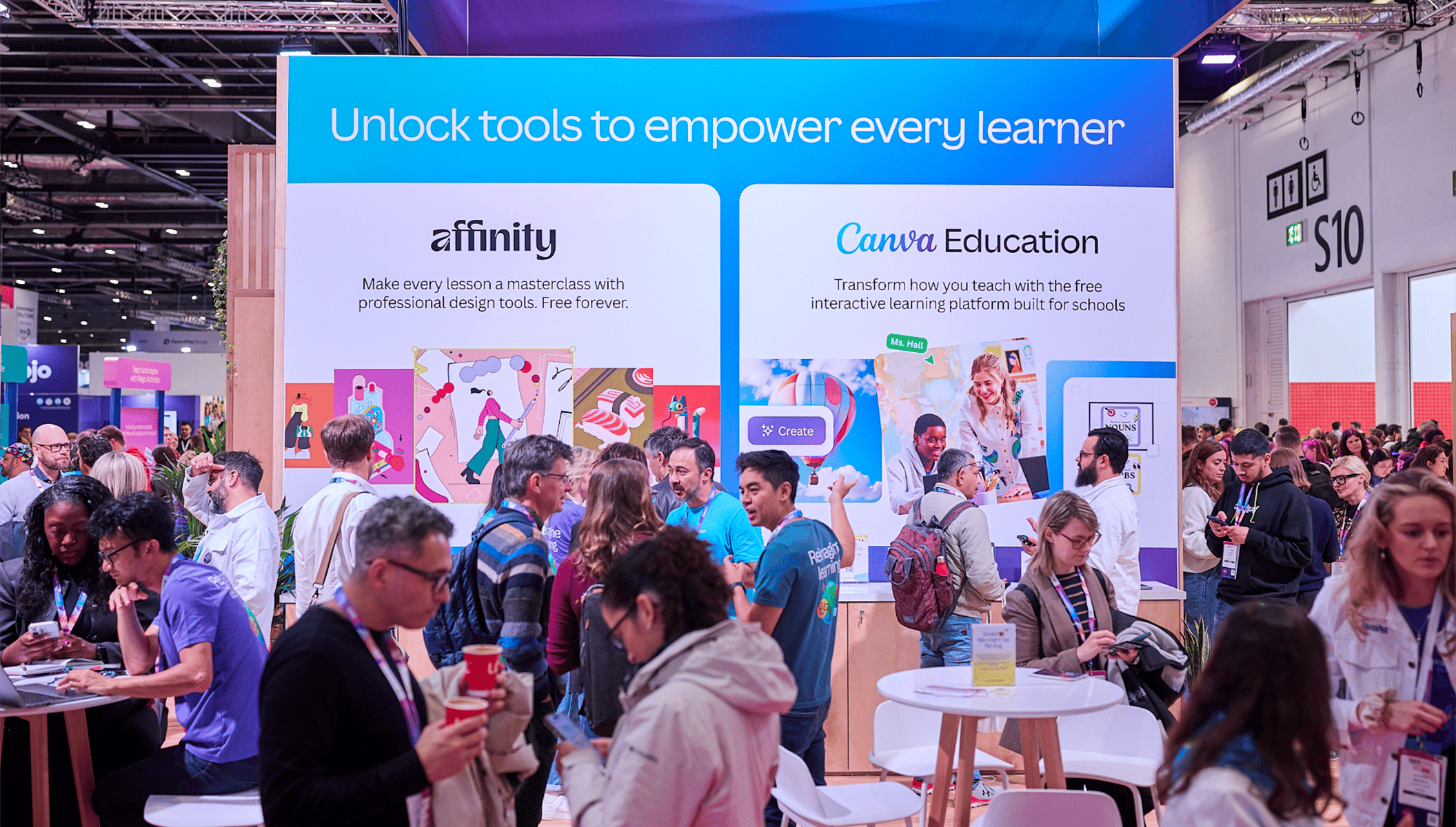
Every January, the global education community comes together at BETT to compare notes on what’s working, what isn’t, and what students need to thrive. This year felt less like uncovering something new and more like acknowledging what has been obvious for some time. The dominant creative software model has normalized scarcity and gatekeeping, and students are paying the price.
For Affinity, the task is clear. We are naming the problem and offering a reset. Professional, progression-ready tools that are accessible, cohesive, and trusted. Free for schools, and usable wherever learning happens.
Across ministries, school systems, and classrooms, the same expectations kept surfacing. Access cannot be selective. Learning cannot stop at the school gate. Trust cannot be conditional. BETT did not create those priorities. It simply confirmed how firmly they are already in place.
The system problem
What we heard from educators was not a series of isolated frustrations, but signs of a deeper, systemic issue. Cost, complexity, trust, and equity are all symptoms of the same underlying design choice. For years, creative education has been shaped around institutional procurement and commercial incentives rather than student outcomes.
- Cost — rationed access: revenue-optimized licensing limits who gets to create. When access is rationed, creativity becomes selective by design.
- Complexity — slowed learning: tools designed to satisfy checklists rather than pedagogy front-load friction and undermine confidence.
- Trust — unpredictable continuity: mid-cycle price shifts and opaque entitlements make long-term planning difficult for educators.
- Equity— compounded disadvantage: if practice can’t continue at home, gaps in skills, confidence, and ambition widen by default.
What this tells us: today’s model rewards scarcity and control. It protects vendor predictability more than student progression. That incentive structure didn’t happen by accident, and it shouldn’t be treated as inevitable.
If learning stops at the school bell, inequity is baked in
Again and again, educators were surprised to learn that students can continue using Affinity at home for free. Reactions like “It feels too good to be true” and “What’s the catch?” came up repeatedly. Not because the offer itself is unusual to us, but because restriction has been normalized for so long. Access at home is not a bonus or an added feature. It is foundational to how people actually learn. Skills develop through practice, iteration, and experimentation, and that work rarely fits neatly into a timetable.
When continuity is guaranteed, expectations shift from rationing access to assuming participation. With Canva and Affinity, school-to-home continuity isn’t an exception. It is the baseline.
Who the current model serves
We don’t need to name competitors to be clear about incentives. Gatekeeping creates predictable enterprise revenue and protects upsell paths. Complex product structures sustain training and certification economies. Sudden price increases, often outside school budget cycles, serve vendor interests ahead of long-term educational planning. In that system, students become users of convenience rather than customers of consequence, and education is left to manage the fallout.
As long as incentives reward scarcity, the system will recreate it. Changing outcomes means changing the model.
Why Affinity is fundamentally different
Affinity is not a classroom-only workaround. It’s a bridge from learning to real creative work — without artificial ceilings.
- Progression without penalty: start simple, then deepen. The same vector, pixel, and layout workflows stretch with skill — no tool-switch whiplash.
- Cohesive, professional workflows: one space for illustration, photography, layout, and Design & Technology — from laser cutting to packaging design — so classroom practice mirrors the real world.
- Pedagogy-ready by design: approachable interfaces, in-app learning, and custom studio workspaces let complexity arrive at the right time, not all at once.
- Continuity built in: free for schools and available at home, so learning continues when motivation is highest — after class, on personal projects.
- Trustable by leaders: clear entitlements, predictable access, and straightforward rollout reduce procurement friction and planning risk.
This isn’t about forcing education into pro tools; it’s about pro-grade tools that respect how people actually learn.
What changes when we reset the model
- Access stops being a budgeting exercise and becomes a design assumption.
- Continuity turns one-off lessons into sustained practice and portfolios.
- Confidence grows because complexity arrives at the right moment, not all at once.
- Equity improves because access to home learning isn’t extra, it’s expected.
- Relevance returns as classroom workflows align with real creative work.
End the scarcity default
Creative education doesn’t need another workaround; it needs a reset. The incentive structure that rationed access and normalized gatekeeping got us here, and it won’t get us out. Leaders face a clear choice: preserve scarcity and call it “industry-standard,” or design for student outcomes and make continuity, progression, and trust the baseline. We’re committed to the latter — and to holding the system to it.


